Benefits of Standardizing Carts and Storage
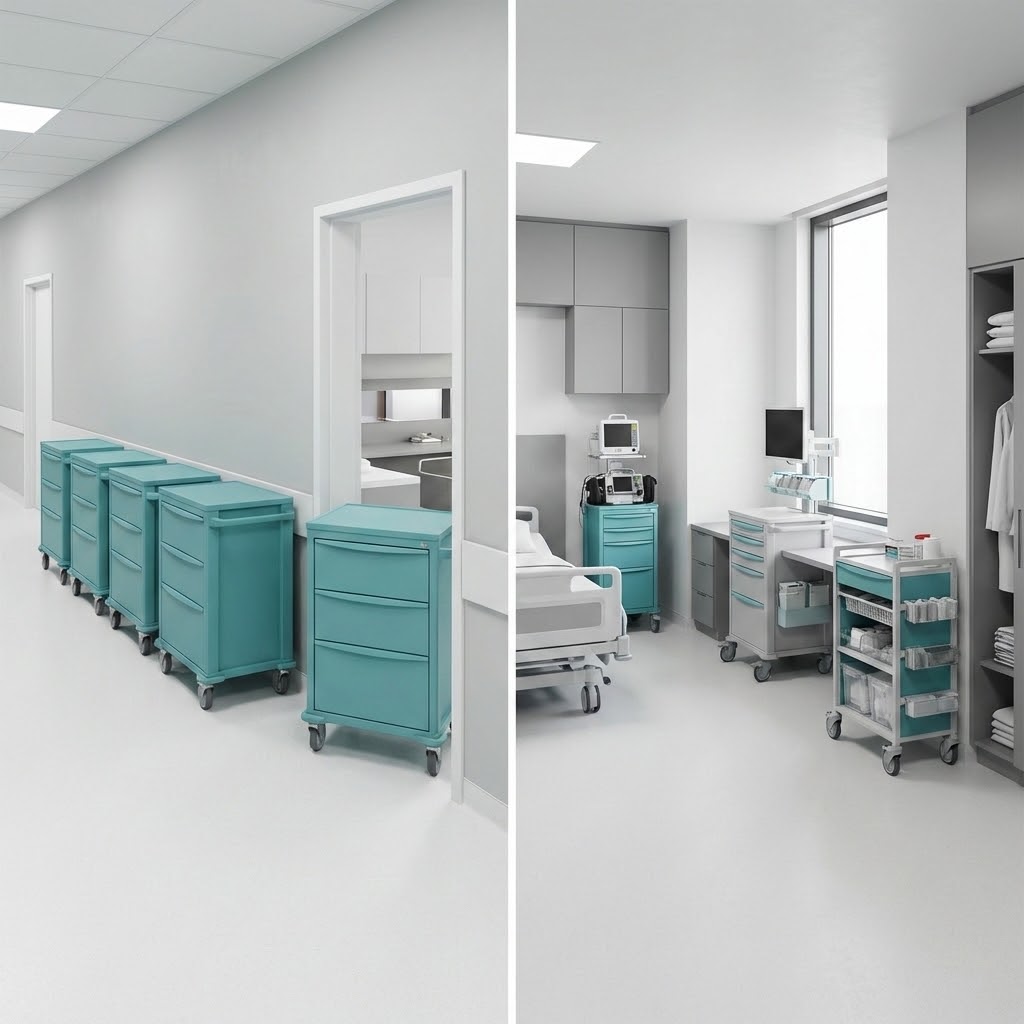
On paper, standardizing carts and storage across a site or region looks like an easy win.
One brand, one platform, common accessories. Easier ordering, greater consistency, cleaner-looking units.
And there are real advantages when the products actually line up with how your teams work. Fewer SKUs, simpler maintenance, and less confusion about “which cart does what” across departments.
The challenge is that not every clinical application fits neatly into a standardized box.
When Standardization Fails Clinical Workflows
Standardization starts to cause problems when you try to make one cart platform do jobs it was never really designed for.
The more specialized the application, the more obvious the tradeoffs become. You might end up with carts that technically meet the spec, but don’t really support how code teams, ICU staff, or anesthesia teams work in real life.
A good example is code response carts.
Code Carts vs Procedure Carts: Why Design Matters
Code carts are a different animal from general procedure carts.
Purpose-built systems such as Metro Lifeline are designed from the ground up for one moment: when a team is running toward a patient who needs help right now.
Details that look small on a spec sheet become critical under pressure:
- How fast specific supplies can be accessed
- How easy it is for multiple people to access the cart at once
- How the layout supports predictable “muscle memory” for the team
- How securely the cart can be sealed, then quickly broken in a code
- How easily a fully loaded cart moves
Those things are hard to bolt on after the fact.
Risks of accessorizing a procedure cart for code response
You can take a general procedure cart and accessorize it to make it “code ready,” but you’re still working around a design that was not built for that use.
You might get something that looks the part, but maybe doesn’t feel right when compromises are having to be made.
That’s where standardization can quietly start to work against clinical care.
What To Do When Your Standard Brand Cannot Meet Clinical Needs
In practice, strict standardization can be limiting. The more you push one platform into every role, the more workarounds staff build into their day. The cart may tick the boxes on the spec, but the team still has to work around it.
And this is precisely where having access to a wider range of brands matters.
It’s not just about more products to pick from (although, yes, choice is nice!). It’s about having options when the “standard” solution doesn’t quite fit, so you can:
- Match the cart to the clinical reality, not just the contract
- Mix and match where it makes sense, while keeping things simple elsewhere
- Avoid over-customizing one platform to do something another already does well
You quite possibly will also need someone who can walk you through the differences without pushing a favourite brand. This is where we step in.
How Forsyth Healthcare Approaches Cart and Storage Standardization
Our view is simple:
- Standardization is great when it supports care and operations.
- It’s a problem when it forces clinical teams to compromise and work around the product.
That’s why we put so much emphasis on conversations, not just catalogs. We always cover:
- Where standardization genuinely helps (training, maintenance, ordering, costing even)
- Where a purpose-built solution is worth stepping outside the standard
- Which brands actually serve specific clinical needs best
We work with multiple manufacturers, and our only agenda is whether you and your stakeholders are satisfied: clinical leaders, front-line staff, procurement, and biomedical or facilities.
If a standardized option does the job, we will say so. If a model from another brand is the better choice, we’ll say that too.
Because at the end of the day, the cart has to work for the people who are pushing it down the hall, not just the people reading the spec.