Choosing a clinical cart should start with how you work, not just what fits on a spec sheet. A “good” cart in healthcare is one that fits the space, supports safe access to supplies, and gives you the most usable storage for the footprint you sacrifice on the floor.
Start with the space, not the catalog
Before choosing any cart, it is worth taking a close look at where it will actually live. The width, height, and depth all need to work within the space, and just as importantly, so do the people who will use it every day. Fit is not only about the cart itself but about how it moves and functions in the real environment, something that is often missed when selection starts with a catalogue or spec sheet.
Under-counter applications bring their own set of considerations. In many facilities, counter depth is about 24 inches and under counter clearance is roughly 36 inches, which sets hard limits on which carts can live in those spaces without sticking out or getting in the way. Some counters may have cove mouldings on floors or plugs in an outlet which reduce the available area even further, and tripping hazards can emerge, especially for carts with protruding bumpers or casters.
Any comparison should first filter carts by what actually fits under your counters and inside your circulation space before you ever talk drawers, locks or colours.
Interior dimensions matter
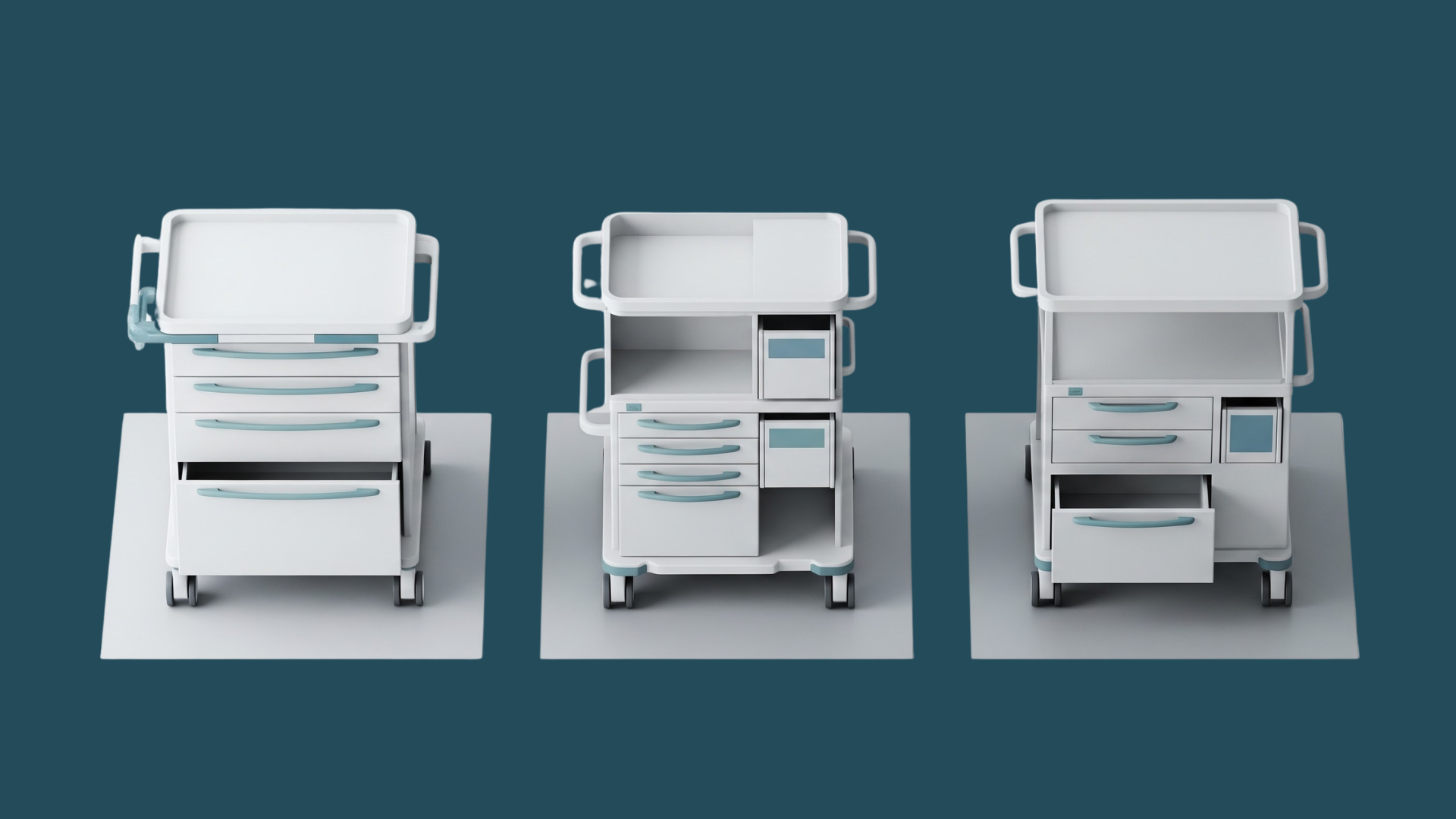
Two carts can look similar on the outside but behave very differently once you start loading them. Take three common standard width models from our own portfolio. The InnerSpace Pace 27, the Harloff M A series, and the Metro Flexline 27 all sit within a very tight band for overall height and width, yet their interior drawer layouts and total usable capacity differ in meaningful ways.
The Pace 27 fits the same 27 inches of drawer space into carts that are about 3 inches lower overall, which effectively boosts usable capacity and makes the top a far more comfortable work surface for most staff. For example, an InnerSpace Pace cart with 27 inches of drawer space sits at roughly 39 inches high, a sweet spot for a shared work surface, while comparable carts from other brands are closer to 42 inches, trading accessibility for extra cabinet height.
Introducing the SpaceImpact Index: capacity by footprint
When we look at overall utility and capacity, we use a calculation we call the SpaceImpact Index, which is simply total interior capacity divided by the carts overall footprint. In the standard width group mentioned above, InnerSpace Pace 27 delivers about 9,801 cubic inches of capacity on a 622 square inch footprint, while comparable Harloff and Metro models sit in a similar range but with slightly larger footprints or different drawer geometries. In the narrow width group, you see the opposite pattern, with Waterloo and InnerSpace trading blows on how much storage they can squeeze into smaller footprints.
SpaceImpact Index snapshot
Below is a snapshot of various common carts, for the purpose of illustrating the relationship between dimensions, footprint, and capacity. For a full list of carts we carry, contact us.
| Cart group | Brand & model | Height (in) | Total capacity (in³) | Footprint (in²) | SpaceImpact Index |
| Standard width | InnerSpace Pace 27 Std | 39.5 | 9,801 | 622 | 16 |
| Standard width | Harloff M/A Med height | 40.5 | 11,259 | 809 | 14 |
| Standard width | Metro Flexline 27 Full | 41.875 | 9,234 | 646 | 14 |
| Standard width | Metro Flexline 27 Narrow | 41.875 | 9,234 | 722 | 13 |
| Standard width | Harloff M/A Med width 27 | 40.5 | 8,508 | 660 | 13 |
| Narrow width | Waterloo Junior Medium 24 | 39 | 6,336 | 379 | 17 |
| Narrow width | InnerSpace Pace 27 Narrow | 39.25 | 4,833 | 372 | 13 |
| Narrow width | Harloff M/A Mini width 27 | 40.5 | 5,751 | 545 | 11 |
*SpaceImpact Index compares capacity per square inch of footprint as calculated by Forsyth. A higher figure indicates more capacity per square inch of footprint.
Matching cart to clinical task
A medication cart, procedure cart and code response cart all have different jobs, so “best” is always context specific. What matters is how interior dimensions, usable capacity and accessory options support the way your team actually works, not just how the cart looks in a brochure.
Having specialists who live in this world every day can make a big difference, helping you translate real workflows into the right mix of footprint, storage efficiency and ergonomics so you are not guessing from a spec sheet. Keep in mind too that carts can be configured to suit any application at no extra cost.
If you are rethinking carts for your unit and want help matching the right interior space and footprint to your workflows, reach out to Forsyth Healthcare and our team would be happy to talk it through.