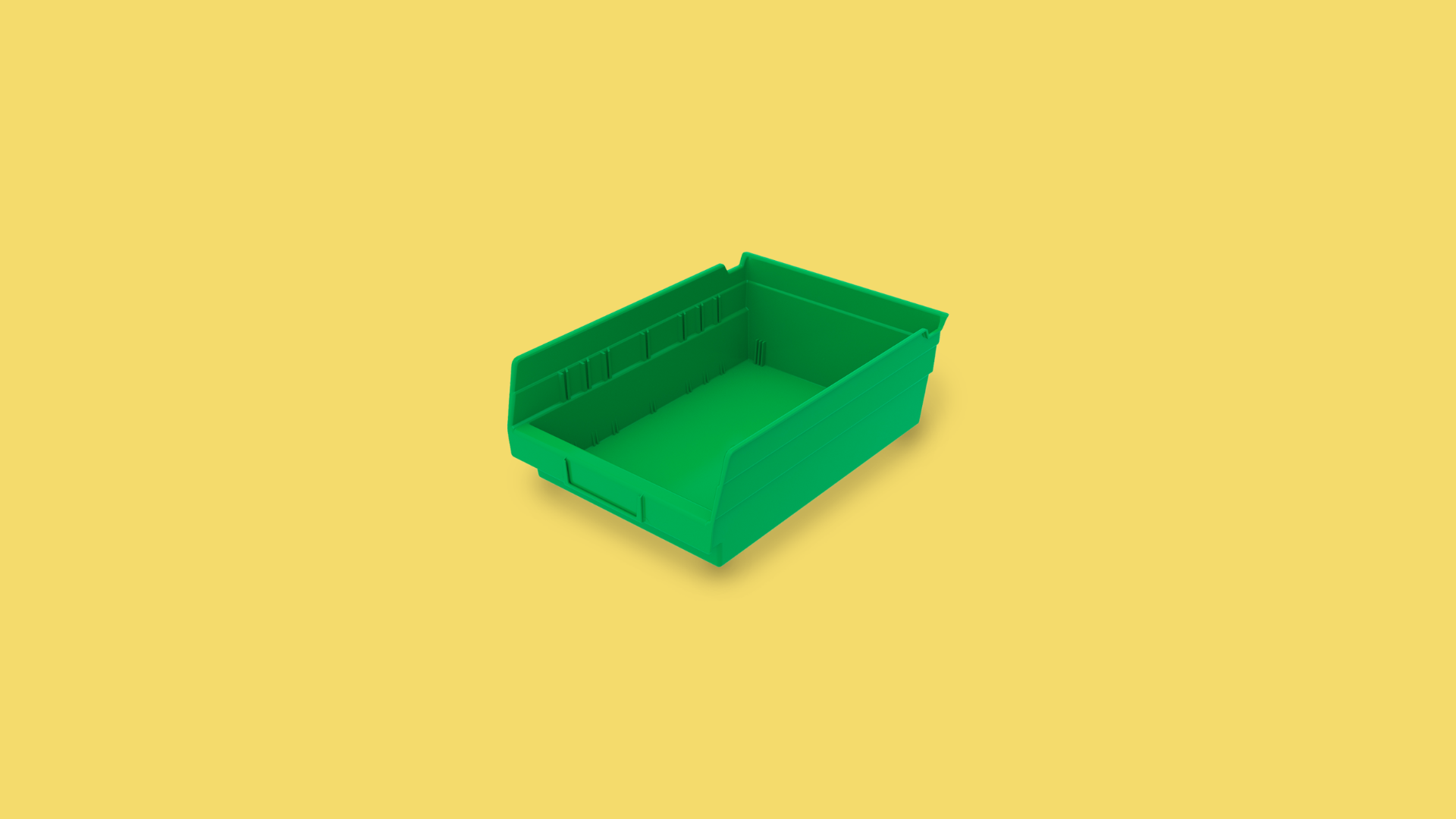
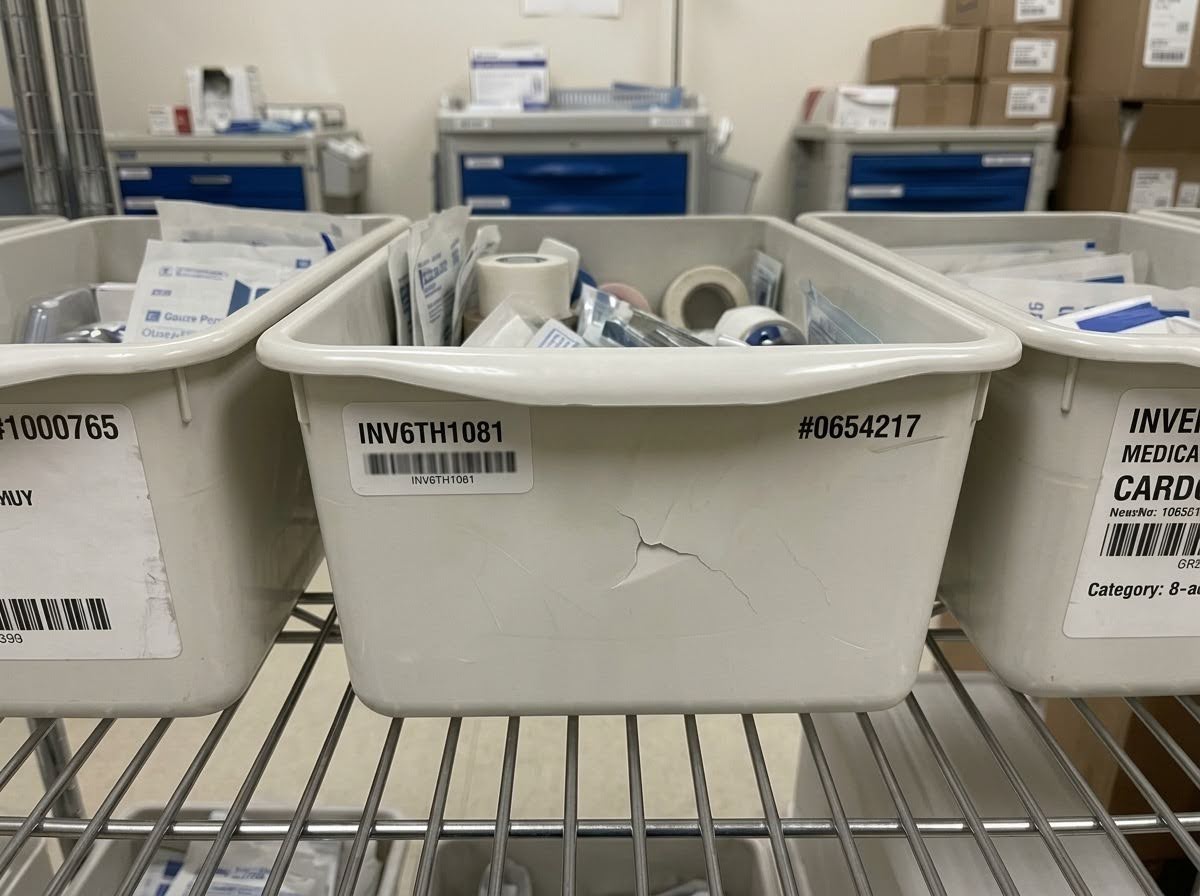
Most supply rooms have them. Rows of plastic bins holding gauze, syringes, tubing, all the small items that a shift runs through without thinking twice.
They are cheap to buy. That is usually the whole reason they are there.
But purchase price is only the first number in a much longer equation, and the rest of that equation gets paid quietly, over years, by the people working in the room.
What happens to a plastic bin over time
A new polymer bin is smooth, easy to wipe, and easy to stack. Give it two or three years of hospital-grade cleaning chemicals and daily handling, and a few things start to change.
The surface develops fine scratches and micro-abrasions. Those are not just cosmetic. A scratched surface holds residue in a way a smooth one does not, which means wiping it down takes longer and works less well.
Corners crack. Lips chip. Bins that once stacked cleanly start catching on each other.
Labels stop adhering properly to a scuffed surface, so they get taped on, or written on with marker, or simply abandoned. The organizational system slowly degrades alongside the bin itself.
None of this happens dramatically. It happens gradually enough that nobody logs it as a problem. It just becomes the way that room is.
The labour nobody counts
Here is the part that rarely makes it into a purchasing conversation.
When a bin becomes difficult to clean, somebody still has to clean it. In most facilities, that somebody is a nurse or a support worker, and the time comes out of a shift that was already full.
A few extra seconds per bin does not sound like much. Multiply it by the number of bins in a supply room, then by cleaning frequency, then by the number of supply rooms in a facility, and the figure stops being trivial.
That labour is real money, charged at a clinical hourly rate, spent on a task that better equipment would have reduced. It just never shows up on the line item that made the bin look cheap in the first place.
Where wire supply baskets come in
Supply baskets solve a different set of problems by being a fundamentally different object.
An open wire basket has far less surface area to hold residue, and the open construction means air moves through it. Cleaning is faster because there is simply less to clean and less that traps anything.
Steel does not develop the same scratch-and-crack pattern that polymer does under repeated chemical exposure. A basket that has been in service for a decade generally still functions as a basket.
Visibility improves too. Open construction means staff can see stock levels from the aisle instead of pulling a bin out to check, which shortens the most common interaction anyone has with a supply room.
And baskets integrate with the shelving and label systems already in place rather than sitting inside them as a separate layer that degrades on its own schedule.
To be fair to the plastic bin
There are genuine cases for polymer.
Small parts that would fall through wire need a solid-walled container. Items that must be fully enclosed for contamination or light exposure reasons need a solid bin. Some low-traffic, low-cleaning-frequency applications will never put a bin through enough cycles for degradation to matter.
The problem isn’t that plastic bins exist but more that they’re frequently chosen by default, for every application in a room, on the basis of the lowest upfront number.
| Feature / Cost Element | Epoxy Finish Supply Basket Unit (36”) | Chrome Finish Supply Basket Unit (36”) | Wire Cart with Plastic Shelf Bins (48”) |
| Unit Price (Estimates) | $3,000 | $2,500 | $1,200 |
| Finish Type | Epoxy coating (softens wire ends) | Nickel chrome finish | Plastic bins on wire frame |
| Storage Efficiency | Baseline (high efficiency) | Baseline (high efficiency) | 30-40% less efficient than baskets |
| Size Comparison | 36” wide | 36” wide | 48” wide |
| Labor Cost Assumption (per hour) | $40/hr | $40/hr | $40/hr |
| Estimated ROI on Cleaning (Monthly Cleaning Protocol) | ~1 year 8 months | ~1 year 4 months | Longer (due to frequent, manual cleaning) |
| Estimated ROI on Cleaning (Weekly Cleaning Protocol) | ~5 months | ~4 months | Longer (more cleaning labor hours) |
Our take
Ask a slightly different question at the specification stage.
Not “what does this bin cost,” but “how many times will somebody clean this, and how long before it needs replacing?”
For a fair number of applications, the answer makes the cheaper option look considerably more expensive. For others, plastic really is the right call. Knowing which is which is most of the work.
If you are reviewing supply room storage for an upcoming project or a refresh, we are happy to walk through where each option genuinely earns its place.