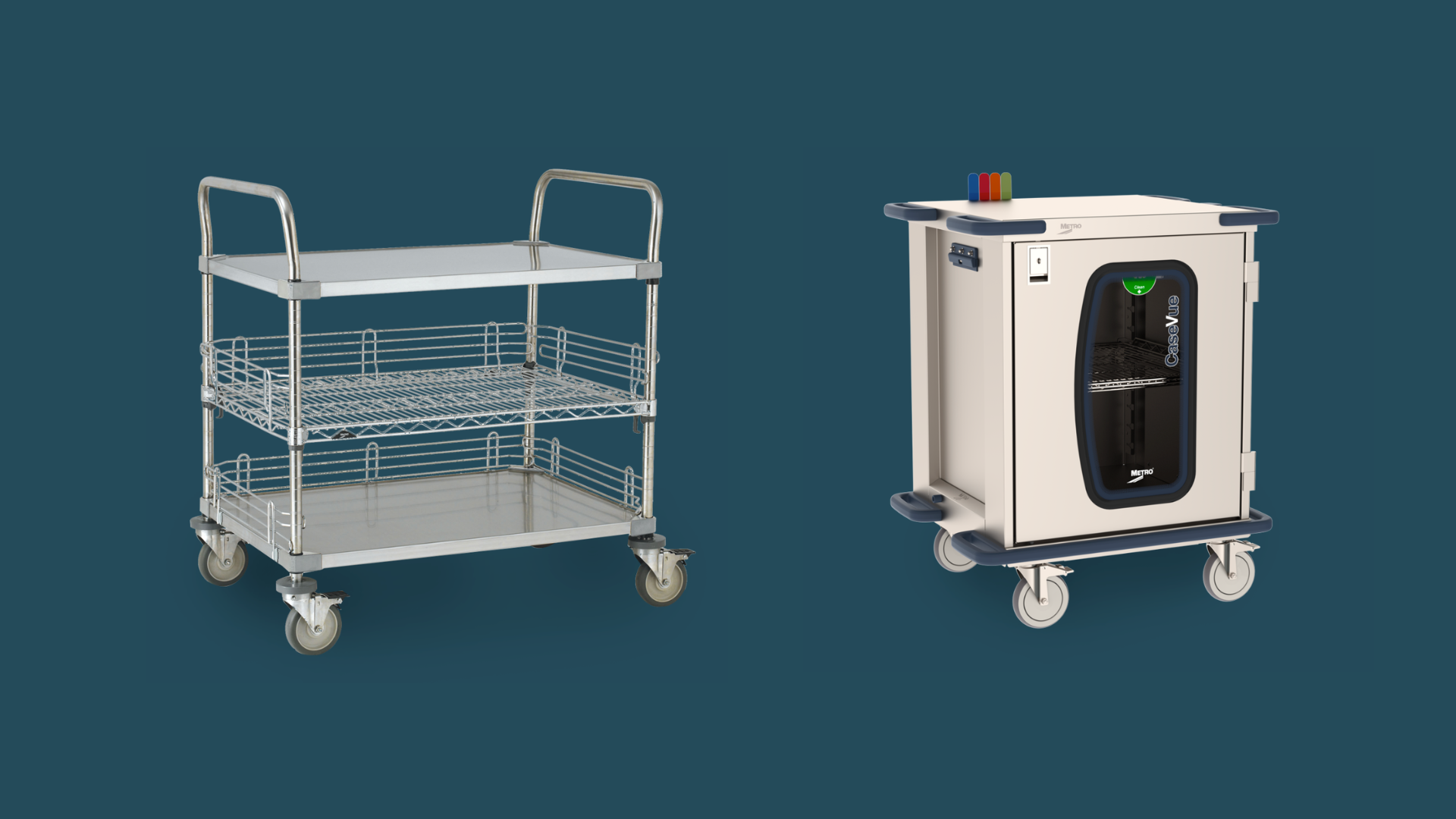
Choosing between closed case carts and open case carts touches almost every part of an OR’s day, from how instrument trays and supplies move cleanly and safely through the building. An understanding of your routes, staging areas, and infection‑control expectations will do more to guide that choice than features on a spec sheet.
What is an open case cart?
Open case carts are usually stainless framed carts with visible shelves and no solid doors. They keep trays and supplies exposed and easy to see.
Where open case carts shine
-
Short, protected routes
- Moving cases between sterile processing and ORs through a controlled core or dedicated path where air and traffic are tightly managed.
-
Fast access
- Teams can see trays at a glance and grab what they need without opening doors or reaching under shelves
-
Lighter weight and maneuverability
- Less material means they are typically lighter and easier to push, especially when fully loaded.
-
Simple cleaning
- Fewer panels and hinges can make washdown straightforward.
Tradeoffs to consider
- Less protection in public corridors or elevators.
- Visible contents (less desirable in public‑facing areas).
- Increased exposure of what’s on the cart
What is a closed case cart?
Closed case carts are fully enclosed with doors (often gasketed) and solid sides. They are essentially mobile cabinets for sterile or soiled items.
Where closed case carts shine
-
Routes through public or semi‑public areas
- Moving cases through elevators, main corridors, or shared spaces where there is more traffic and variable air quality.
-
Protection from contamination
- Doors and panels provide a physical barrier for sterile trays and linen in transit and staging.
-
Visual and noise control
- Contents are hidden, which keeps public or family‑facing areas looking cleaner and less cluttered.
-
Clean/dirty workflows
- Paired clean/dirty indicators and sealed interiors can support clear processes between OR and SPD.
Tradeoffs to consider
- Heavier and sometimes harder to maneuver in tight spaces.
- Slightly slower access to contents (opening doors, managing latches).
- More hardware (hinges, gaskets) to maintain, clean and dry.
Closed case carts vs open case carts: quick comparison
| Aspect | Open case carts | Closed case carts |
| Protection in transit | Lower – best for protected core routes | Higher – better for public and mixed corridors |
| Visibility and access | High – everything is in sight and easy to grab | Lower – contents are protected behind doors |
| Infection control barrier | Minimal physical barrier | Strong barrier for sterile or soiled items |
| Maneuverability | Generally lighter and easier to push | Heavier; design and casters matter more |
| Aesthetics in public areas | Exposed trays and packaging | Clean exterior, less visual clutter |
| Best fit scenarios | Short, controlled sterile routes and back rooms | Public elevators, long hallways, and staging near ORs |
Which should your OR use?
A good place to start is taking a good look at the routes your case carts run, then choosing the cart that fits those paths and the job.
- If your case carts move entirely inside a sterile core, on short, predictable routes, open carts can give you better visibility, fast access, and lighter handling for staff.
- If your case carts run through public elevators, long corridors, or mixed‑use spaces, closed carts are usually the safer choice for contamination risk, patient perception, and compliance expectations.
- Some sites do both: closed carts for main transport, then open or partially open solutions for staging and in‑room use.
You can also layer in material choices. Polymer elements such as cool touch handles, modern bumpers, and high‑quality casters help both open and closed designs move more quietly and protect wraps and doors in tight OR corridors.
How to decide for your site
In existing ORs, walking the route together usually makes the right cart choice obvious. In new builds and major redevelopments, you can’t walk it yet, so you have to do the next best thing: map the route carefully on plans and pressure‑test it with the people who’ll use it. A few practical questions to ask:
- Exactly which doors, corridors, and elevators will case carts use, and who else uses those spaces?
- How long are cases staged before surgery, and where do they sit?
- How often do you have to turn rooms and cases quickly, and does access speed or protection matter more in those moments?
- Are there specific infection prevention concerns (e.g., construction, shared elevators, historical issues) that point clearly toward a closed design on some routes?
Most ORs land on a mix of solutions that reflect their own building, workflows, and risk tolerance rather than a single “right” cart for every situation. If you are re‑examining case cart standards or planning a new route from SPD to the OR, Forsyth can help you map the paths, surface the tradeoffs, and line up the cart designs that make the most sense for your team.