This is a guest post from Forsyth Healthcare Director Shad Forsyth.
If you want to start an argument in a hospital, try asking four people how much time they lose every day because of storage and carts.
Someone will say “not much,” someone else will say “way too much,” and a third person will shrug and tell you they have stopped counting.
What most teams don’t have is a simple way to connect storage choices with time, steps, and space in a way that shows up on a calendar or a budget line.
That’s what I want to explore here. Not a theoretical model, just a practical way to think about how much storage can actually save you when it’s designed well.
Storage is not just where stuff lives
A lot of drawings treat storage like background scenery. Rooms are labeled, square footage is assigned, a few rectangles appear in the plan, and everyone moves on to talk about major equipment and clinical flows.
On the floor, storage is not scenery. It’s a daily coworker. Every time a nurse leaves a room to go hunting, every time someone has to move three things to reach the one thing they actually need, the system is quietly leaking time and attention.
I walked into a new space recently where the rooms looked great on paper.
The carts were lined up neatly, everything had a label, and the layout ticked all the boxes. Six weeks later, the same space told a different story. Overflow was stacked on top of carts. Extra boxes lined the hallway. Staff had found their own shortcuts because the design did not match the way they actually worked.
Nothing catastrophic had happened. But if your team is constantly working around the storage, that’s real cost, even if it never appears in a report.
What we know about time and workflow
You don’t need a stack of research papers to know that better storage helps people move faster and with less frustration. Most nurses and materials teams could tell you that in one sentence.
But there is some useful data out there. When hospitals reorganize how and where supplies are stored, they often see two things at once. The time staff spend collecting and putting away materials drops sharply, and satisfaction with the work environment goes up.
Those gains usually don’t come from expensive technology. They come from boring sounding changes such as clearer zoning of items, more logical placement, and reducing the number of trips it takes to get through a task.
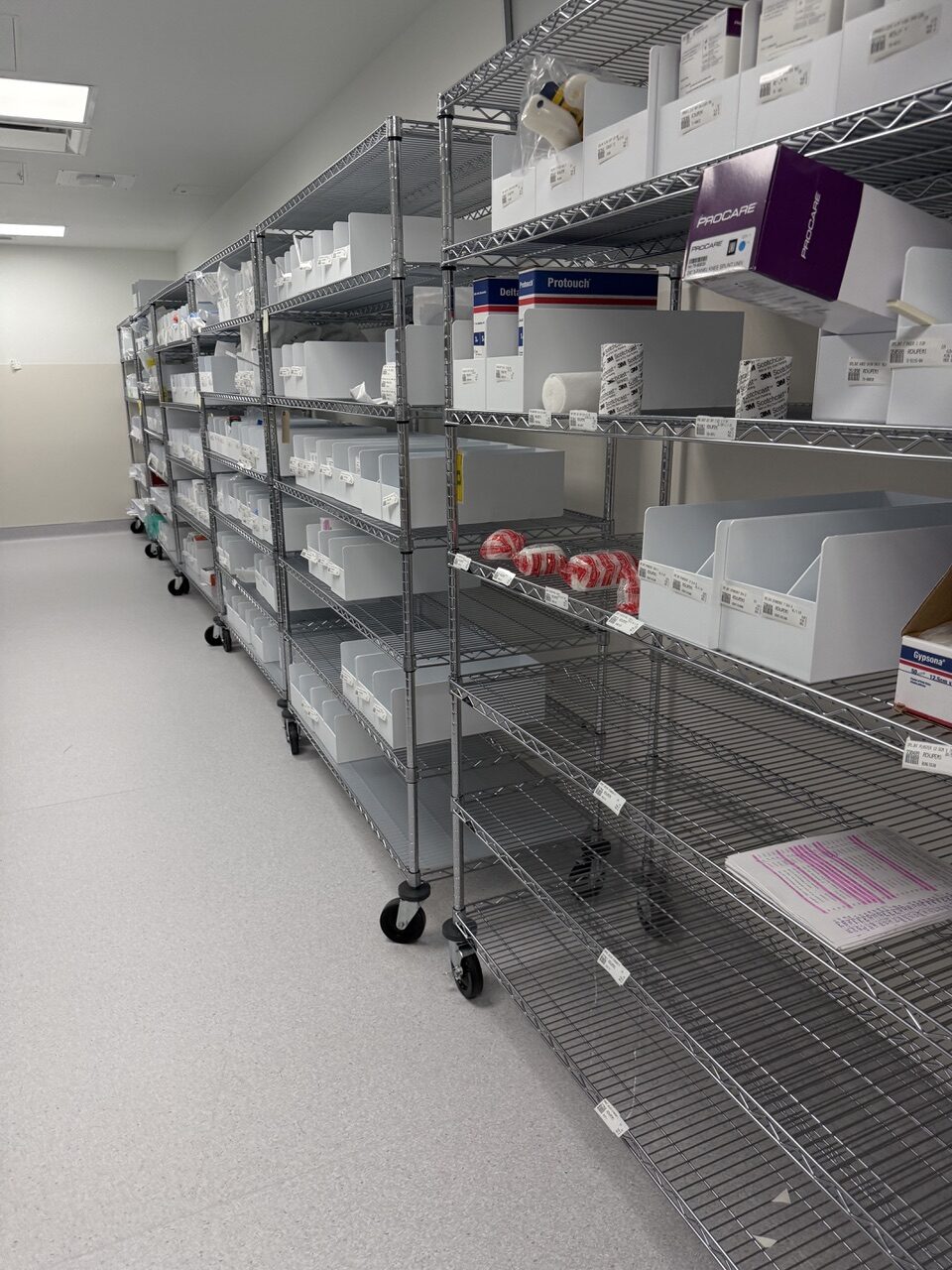
Nicely organized but how many people can reach those top shelves?
If you are a leader or a planner, it helps to think about storage like any other workflow question.
- Where are we forcing people to take extra steps.
- Where are we interrupting their focus.
- Where are we asking them to remember workarounds that never show up in policy.
Three simple things you can measure
You don’t need a formal study to start understanding the impact of storage in your own building. You can begin with three simple observations.
One. How often do people leave the room mid-task?
Pick one room, one shift, and literally count how many times someone walks out to find a missing item. You might be surprised by the number, especially on nights and weekends.
Two. How long does restocking actually take?
Time one restocking cycle for a typical cart or supply bay. Start the clock when the staff member starts gathering supplies, and stop it when the cart is ready for use again.
Three. How many items end up in the wrong place?
At the end of a shift, walk the same room and note how many items are out of place or living in unofficial “temporary” spots. Those are clues that the current layout is not lining up with reality. To make this easier, consider taking a photo in the morning and a photo at the end of the day. A literal “before and after” comparison can be a simple and effective way to identify what’s strayed from its rightful home.
If you repeat those same observations after a modest refresh, you will start to build your own story about what storage is costing you and what it can save.
It does not have to be perfect. It just has to be honest.
The design levers that do the most work
Once you have a sense of where time and steps are leaking away, the next question is what to change. In my experience, it’s just a small handful of levers that do most of the work.
First, get serious about fast movers and slow movers.
- The items people reach for constantly should be closest, easiest, and most obvious.
- The items that rarely move can live further away or higher up.
Second, right size your containers and bays.
- If you are cramming large items into tiny spaces, those items will migrate to the nearest flat surface.
- If the bins are far too big, you end up with partial boxes and overflow that no one quite knows what to do with.
- On the other hand, if bins are too small for the shelf, you instantly create wasted space.
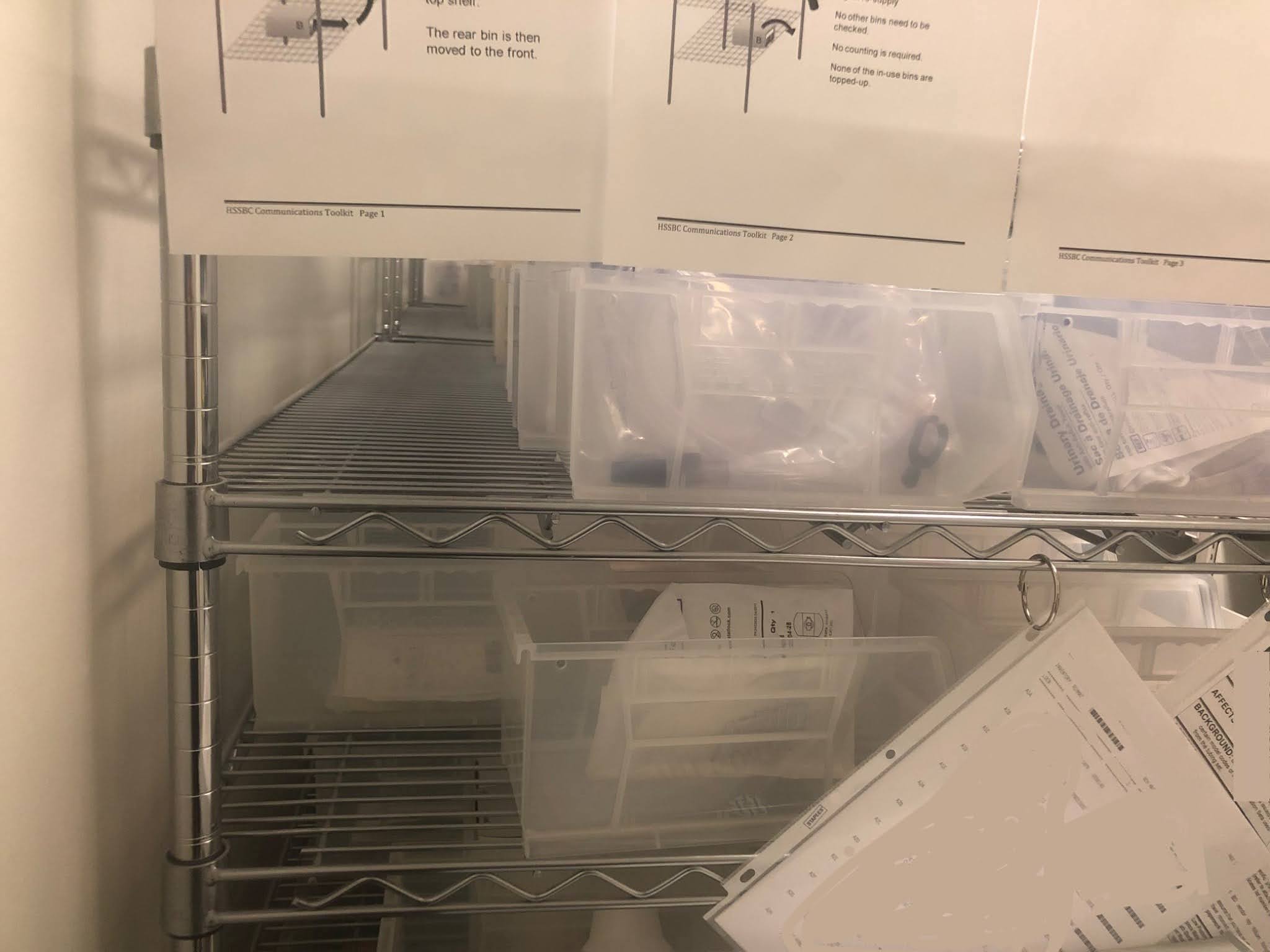
Look at all that space!
Third, use the vertical space thoughtfully.
- Tall is not always better.
- If you push carts or shelving up to the ceiling, you may gain storage but lose ease of cleaning and safe reach.
- The best designs are optimized both to the square footage available for the inventory to be stored, and to the natural and safe movements of the human body.
Finally, aim for consistent visual cues.
- When labels, categories, and layouts are consistent across a unit, staff don’t need to relearn each room from scratch.
- That reduces cognitive load, especially on busy days when people are already stretched.
Avoid “more stuff, same problems”
There is always a temptation to solve storage problems by buying more of it.
More carts, more shelving, more bins. Sometimes that’s the right call. Often it just spreads the same problems over a larger area. I’ve seen sites add an entire bank of shelving only to discover that staff were still walking the same extra distance because the layout itself never changed. They had more capacity, but the same friction. Thinking about storage only in terms of square footage or lineal feet is a smart starting point, but shouldn’t be the entire conversation.
Before you add anything new, ask a simple question: If we dropped this cart or shelf into the room as it’s today, what behaviour would actually change?
If the honest answer is “not much,” the layout and logic probably need attention before the catalog does.
A simple place to start:
Pick the one room your team complains about the most.
Over the next month, do three things.
- Watch how people move through that room for a single shift.
- Ask them what slows them down or irritates them.
- Make one small change based on what you see and hear, then watch again.
You don’t need to rebuild your entire cart fleet to make an impact.
You just need to treat storage as part of the work, not background furniture.
If you ever want a second set of eyes on a room or a cart layout, I am always happy to look at a quick sketch or a few photos and share what I see.
Sometimes an outside perspective is all it takes to turn a daily irritation into an easy win.