If you are trying to comply with CSA standards for clean and sterile supply storage, the hard part is usually not the intent. The challenge is translating broad standards and infection prevention guidance into decisions about rooms, shelves, bins, cardboard, cleaning routines, and day-to-day habits.
This guide is designed to make that simpler. It is an educational overview for healthcare teams and facilities leaders, and it shouldn’t replace your organization’s infection prevention policies, reprocessing guidance, and local authority requirements.
This article is meant to be a helpful guide, but should not replace your own consultation with CSA or other guidelines that are relevant to your facility or jurisdiction. Always do your own research.
What CSA is trying to protect
At the broadest level, CSA guidance on clean and sterile supply storage is about protecting package integrity and reducing contamination risk during storage, handling, and transportation. Public Health Ontario does a good job framing the issue in practical terms: sterile items should be stored in a clean, dry, dust-free area, protected from debris, drains, moisture, and vermin to help maintain sterility.
That means compliance is not only about buying the right shelving. It also depends on the room, the surfaces, the environmental conditions, the access controls, and how consistently the space is maintained.
What a compliant clean supply area generally includes
Across provincial guidance documents that reference or align with CSA principles, the same themes appear again and again. Clean and sterile supplies should be stored in a dedicated, enclosed, and secured area with adequate storage space to prevent crushing or damage to packaging.
A strong clean supply room will typically include:
- Protection from dust, moisture, debris, vermin, and unnecessary traffic
- Storage space that prevents packages from being bent, crushed, or overhandled
- Restricted access or enclosed storage when access cannot be controlled
- Stock rotation practices that support first-in, first-out use and reduce expired product risk
Shelving requirements teams often miss
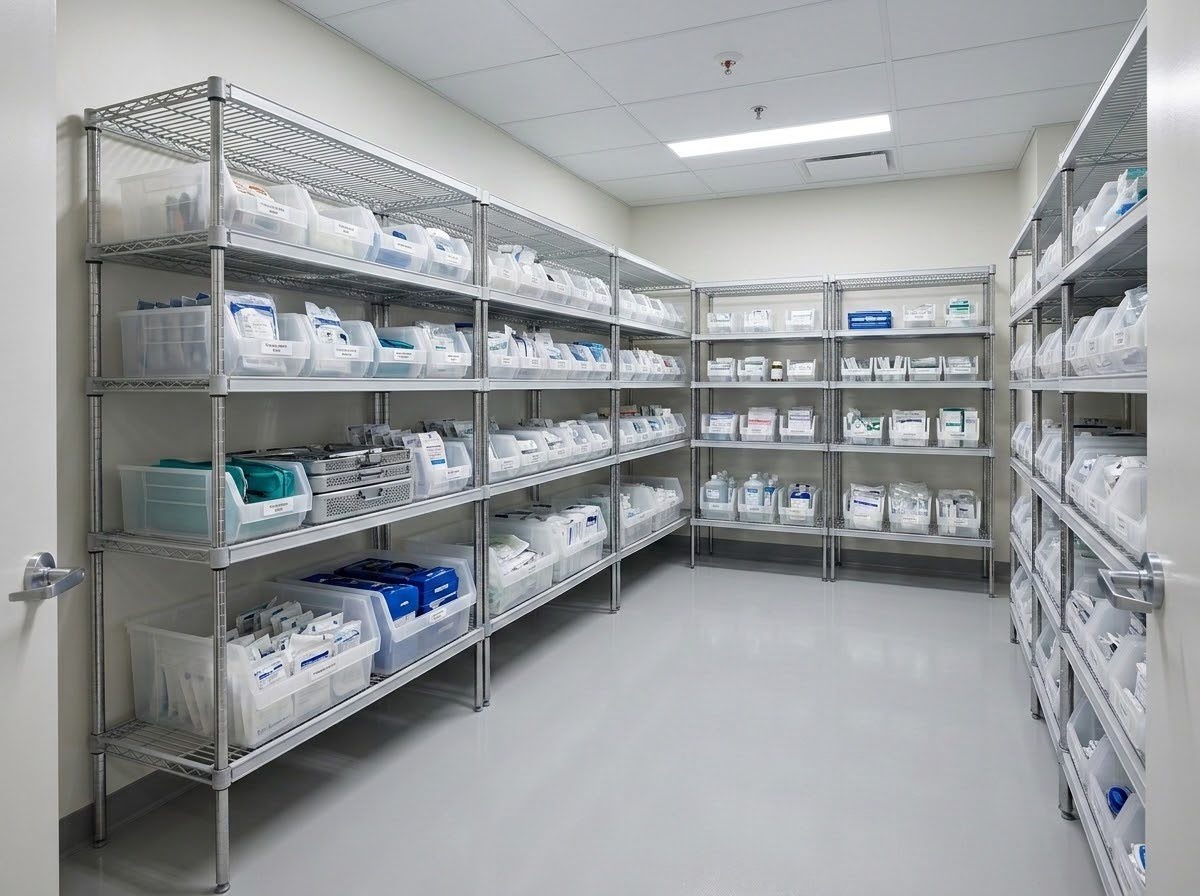
A lot of compliance issues come down to shelving details. PHO states that shelving for sterile items should be constructed of non-porous, non-shedding, easily cleanable materials, and be free of burrs and rough edges. It also notes that the top and bottom shelves should be solid. In practice, this rules out painted shelving that can chip or flake over time, since those surfaces are considered shedding rather than truly cleanable and non-shedding. Translucent shelf liners are acceptable as covers for top and bottom shelves, and are used in many facilities specifically to support dust control while still allowing thorough cleaning.
Despite how clear this looks on paper, we still see common issues in real-life storage rooms. Bottom shelves are frequently set less than 10 inches off the floor, even though guidance expects at least 10 inches (about 25 cm) of clearance for sterile and clean supplies to stay above dust and mop splash and to allow proper cleaning underneath. Top shelves are often treated as open storage instead of dust covers; when that happens, supplies should only be stored there in closed, cleanable containers so packaging is protected from falling dust and debris. Together, these small deviations from the standard can quietly undermine an otherwise well-designed storage space.
Regional guidance aligned to CSA principles goes further with practical spacing rules. Fraser Health and Interior Health both note that shelving for clean and sterile supplies should be at least 10 inches off the floor, 18 inches from the ceiling, and 2 inches from outside walls. Fraser Health also specifies that shelving units or cart surfaces should be smooth, cleanable, non-porous, and tolerant of hospital-grade disinfectants, and that wood is not acceptable.
Can clean and sterile supplies be stored in cardboard boxes?
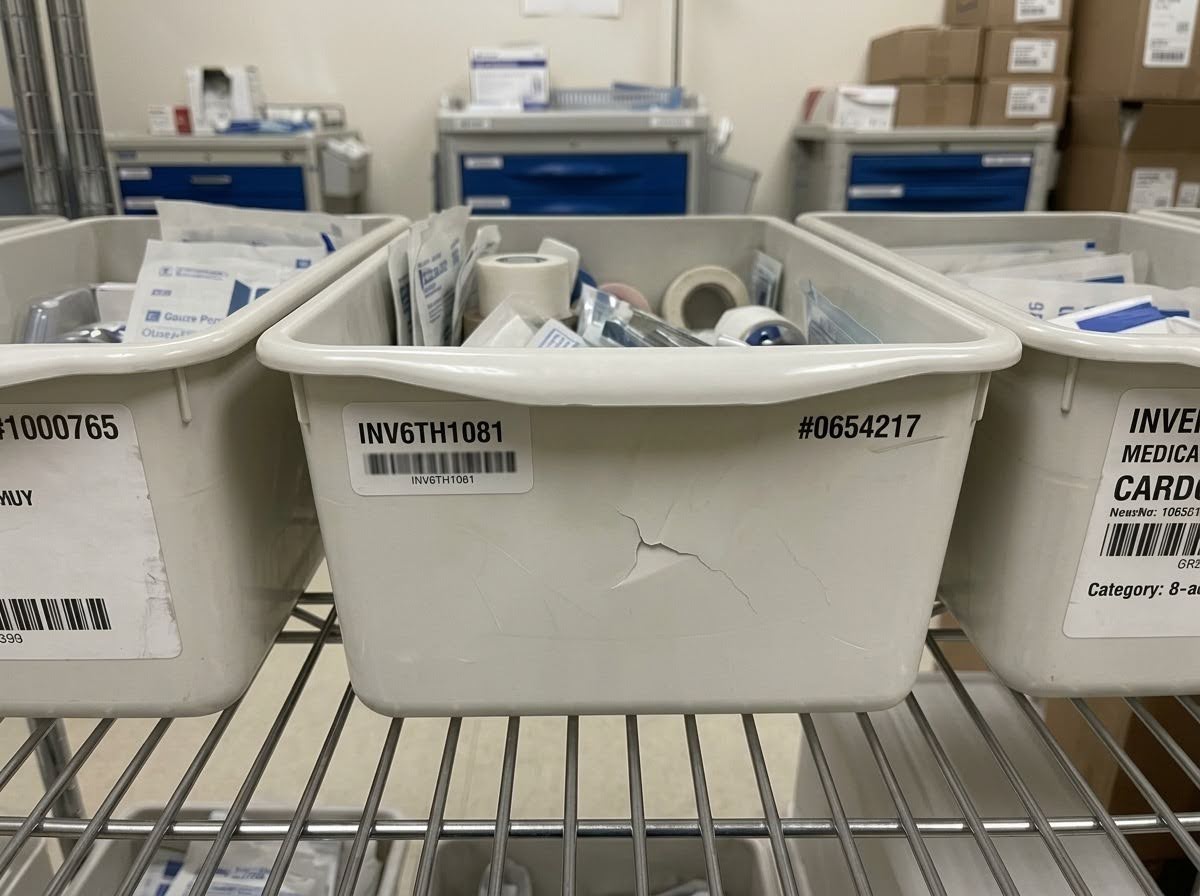
In designated clean supply areas, corrugated cardboard is a problem. Containers used for storage of clean equipment and devices should be moisture-resistant and cleanable, and that cardboard boxes must not be used. Fraser Health and Interior Health emphasize that direction, advising that corrugated cardboard and external shipping containers stay out of clean storage spaces.
Decanting matters. If product arrives in shipping cartons, many facilities transfer it into cleanable bins, totes, drawers, or shelving systems before it enters the clean supply room. This can feel tedious, but it is closely tied to keeping dust, debris, and non-cleanable packaging out of controlled spaces.
What should be kept out of a clean supply room?
A compliant clean supply area is usually defined as much by what is not there as by what is there. Guidance from Fraser Health, Public Health Ontario, and Interior Health consistently points away from mixed-use storage and contamination risks.
That typically means avoiding:
- Soiled supplies or dirty equipment
- Sinks or handwash sinks inside the clean supply room
- Storage under sinks, under exposed pipes, or on windowsills
- Uncovered hallway or alcove storage for sterile supplies
- Direct exposure to moisture, direct airflow, sunlight, or heavy traffic
Environmental conditions and cleaning expectations
Generally sterile storage areas should maintain temperatures between 18 and 23 degrees Celsius and relative humidity between 30% and 60%. Those environmental controls matter because moisture, dust, and temperature instability can all affect package integrity over time.
Cleaning expectations also need to be defined. Fraser Health provides a useful example, calling for daily cleaning of counters and floors in clean supply rooms, monthly cleaning of shelves and containers, and periodic cleaning of walls and fixtures. Those intervals may vary by organization, but the principle does not: a clean room only stays compliant if the cleaning routine is real and owned.
Practical checklist for CSA-aligned clean supply storage
Use this as a quick screening tool for a room or project.
| Question | Why it matters |
| Is the room dedicated to clean and sterile supplies only? | Mixed-use rooms raise contamination and traffic risks (via fraserhealth) |
| Are shelves smooth, cleanable, non-porous, and properly spaced? | Material and clearance requirements are recurring guidance points (via fraserhealth) |
| Are supplies protected from moisture, dust, crushing, and damage? | Package integrity is central to compliant storage (via scc-ccn) |
| Has corrugated cardboard been removed from the clean storage area? | Cardboard is not considered appropriate storage in designated clean spaces (via fraserhealth) |
| Are stock rotation and cleaning routines clearly defined? | Daily habits determine whether the room stays compliant (via fraserhealth) |
| Is access controlled, or are supplies enclosed if access cannot be controlled? | Restricted access is a recurring expectation in guidance (via fraserhealth) |
Our take
The standards and related guidance are directionally clear. They push healthcare teams toward cleaner rooms, better storage discipline, and fewer workarounds. That is a good thing.
Where compliance sometimes becomes challenged is usually not with the rule itself, but with the reality of older rooms, undersized storage areas, mixed-use utility spaces, or supply volumes that outgrew the original design years ago. In those situations, the question to ask is “How do we make this room work without breaking the intent of the standard?”
In the end, compliance is as much a planning, workflow, and design decision as much as it is a product decision.
FAQ: Clean and Sterile Supply Storage in BC and Alberta
Every health authority will have its own infection prevention and control policies, procedures, and supporting documents for clean and sterile supply storage. The answers below are meant to sit alongside those resources, not replace them. For your specific jurisdiction in Canada, always consult your local health authority or Infection Prevention and Control (IPC) team for definitive guidance.
What standards or guidance apply in BC and Alberta?
In BC…
All BC health authorities have guidance that supports CSA-aligned clean and sterile storage practices, even though the documents and formats differ. Interior Health’s Clean and Sterile Supply Storage Guide and Fraser Health’s Guidance for Storage of PPE and Clean Supplies are two published examples that spell out expectations for room designation, shelving, environmental controls, and daily habits. Vancouver Coastal Health also provides “Storage of Clean and Sterile Supplies (All Care Settings),” which frames how clean and sterile supplies should be stored in controlled, designated clean areas and at point of care.
In Alberta…
Alberta Health Services’ Storage of Clean and Sterile Supplies in Clinical Areas is a provincial best practice guideline that references CSA Z314 and sets requirements for handling, transporting, and storing clean and sterile supplies outside MDR areas. AHS also supports this with related materials on cleaning clinical storage areas and CSA-derived cleaning frequency tables for sterile storage spaces.
Can sterile supplies be stored on open shelving?
In short, yes.
In BC…
Interior Health’s guide states that shelving for clean and sterile supplies should have a solid top and bottom shelf or liner, with shelves that are smooth, non-porous, and able to withstand disinfection. It also specifies that shelving should be 250 mm off the floor, 450 mm from the ceiling, and 50 mm from outside walls. Fraser Health’s guidance echoes this, noting that shelving units or cart surfaces must be cleanable, smooth, and non-porous, with top and bottom shelves solid and clearances of at least 10 inches off the floor, 18 inches from the ceiling, and 2 inches from outside walls. Vancouver Coastal Health reinforces the same principles for all care settings: sterile supplies on shelving should be kept off the floor, away from windowsills and sinks, and protected from dust and moisture
In Alberta…
AHS guidance indicates that clean and sterile supplies can be stored on open shelving provided that shelving surfaces are smooth, non-porous, and easily cleaned, and that items are elevated off the floor and protected from dust, moisture, and damage. Local Infection Prevention and Control (IPC) teams may set specific clearance expectations based on CSA and site design.
Can cardboard boxes be kept in clean supply rooms?
In short, no.
In BC…
In BC, clean and sterile supply rooms are expected to be free of corrugated cardboard and external shipping containers. Health authority guidance consistently notes that cardboard cannot be adequately cleaned, that dust and bacteria collect in its grooves, and that it is susceptible to moisture, vermin, and other contaminants. As a result, supplies should be decanted from shipping cartons outside the clean supply area and stored in moisture-resistant, wipeable, cleanable containers or on appropriate shelving instead.
In Alberta…
AHS guidance notes that clean and sterile supplies should be stored in cleanable containers and on appropriate shelving, and that shipping cartons or corrugated cardboard are not suitable for ongoing storage in clean supply rooms. Facilities are expected to decant supplies into cleanable bins, drawers, or shelves before placing them in designated clean storage areas.
Can there be a sink in the clean supply room?
No.
In BC…
In BC, clean and sterile supply rooms are expected to function as dry, dedicated storage spaces without sinks. Interior Health’s Clean and Sterile Supply Storage Guide explicitly states “No sinks” in Tier 2 clean supply rooms and notes that no decontamination or cleaning should occur in those spaces. Fraser Health’s guidance similarly specifies that clean supply rooms shall not include a hand hygiene sink inside the room and that the hand hygiene station should be located outside the clean storage area. Across BC resources, the pattern is consistent: sinks and splash zones are kept out of clean and sterile supply rooms, and supplies are not stored on or under sinks.
In Alberta…
AHS guidance indicates that clean and sterile supplies should not be stored under sinks, near splash zones, or in areas exposed to moisture or drains. Hand hygiene facilities should be accessible but positioned so water does not contaminate clean storage. Specific sink placement is typically determined as part of IPC review and CSA-aligned design.
What temperature and humidity should clean and sterile storage rooms maintain?
In BC…
Interior Health notes that clean and sterile supply rooms must protect supplies from temperature changes and high humidity, and calls out the need to shield supplies from sunlight, condensation, and environmental extremes. Fraser Health stresses that storage areas should be protected from moisture, dust, and the entry of dust from adjacent areas and ventilation systems. Vancouver Coastal Health refers facilities to CSA and broader provincial guidance for specific environmental parameters while emphasizing that sterile packages must maintain their integrity until point of use.
In Alberta…
AHS guidance references CSA Z314 and expects sterile storage areas to maintain controlled temperature and relative humidity within ranges appropriate for packaging integrity and device sterility, as defined by CSA and local IPC policies. Facilities typically rely on building systems and monitoring to ensure those ranges are maintained.
Who decides if my current room meets these expectations?
In BC…
In BC, clean and sterile supply rooms are usually assessed through a combination of Infection Prevention and Control (IPC), facilities or capital planning, and licensing/accreditation processes at your health authority. The Provincial Infection Control Network of BC (PICNet) provides provincial-level guidance, while each health authority (Fraser Health, Interior Health, Vancouver Coastal Health, Island Health, Northern Health, Provincial Health Services Authority, and the First Nations Health Authority) has its own IPC policies and tools that support CSA-aligned storage practices.
In Alberta…
Within AHS, Infection Prevention and Control and Clinical Engineering or Facilities teams review storage rooms against AHS guidance and CSA requirements, and may recommend changes to shelving, use, or environmental controls to bring spaces into alignment.
If there is any uncertainty about a specific room, the most reliable step is to consult your local IPC team or facilities contact at your health authority and ask which clean and sterile storage guideline they use as their reference for that site.