This is NOT a paid or promoted post! We live and breathe carts, and when something new comes to the market, we can’t help but dive in.
Some carts are easy to categorize.
And then there’s Nimbl.
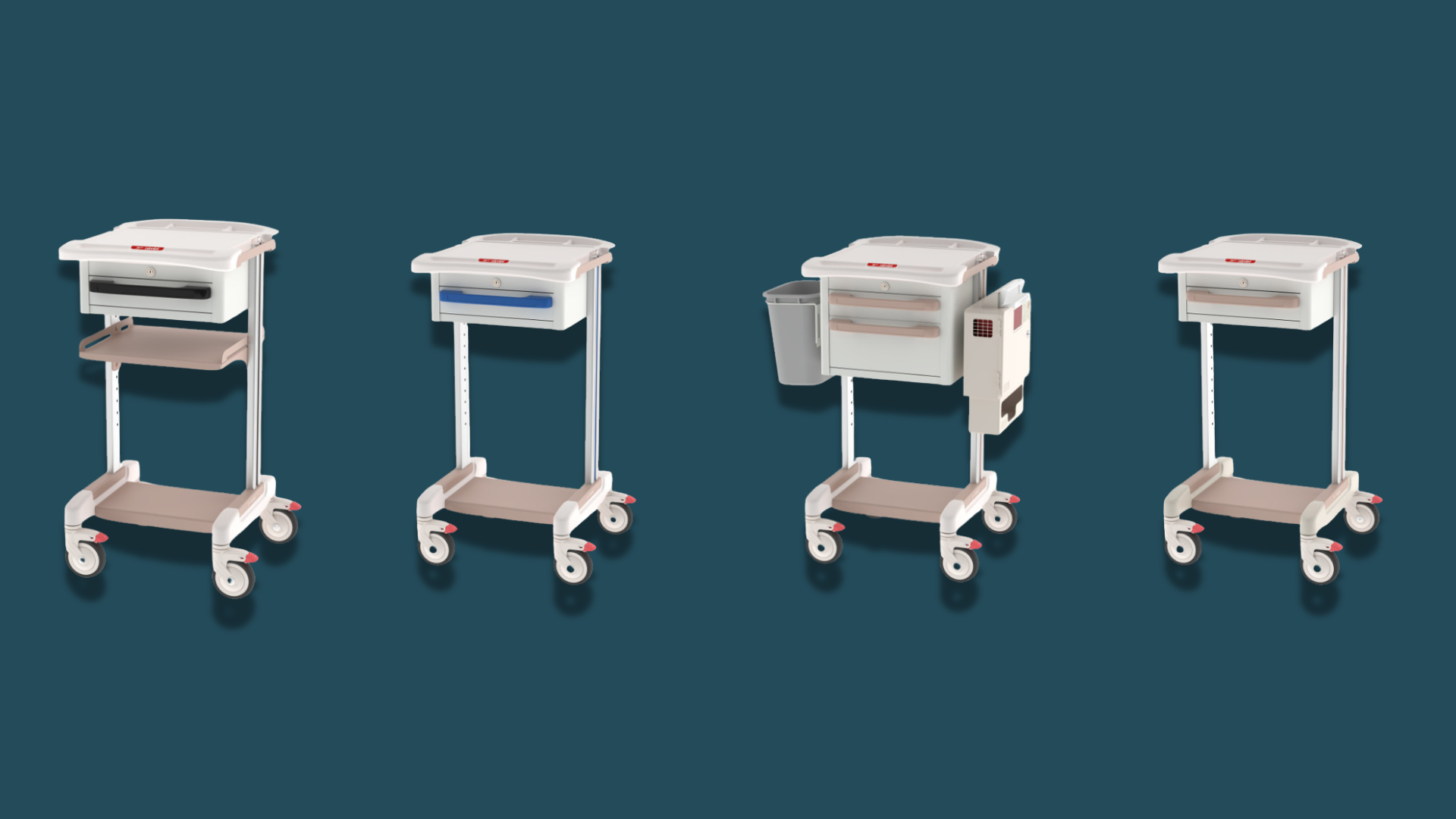
Metro’s new Nimbl line sits in that interesting space between equipment cart, procedure cart, and lightweight mobile workstation. Needless to say, it’s caught our attention.
Teams working in tight rooms or fast-moving clinical environments will love the flexibility. A cart that can support a device, hold a few key supplies, and still give staff a usable surface to work from can take pressure off the room without taking over the room.
Why Nimbl stands out
What makes Nimbl interesting is not that it tries to do everything. It’s that it seems built for those in-between jobs that never fit neatly into one cart category.
On a compact frame, Metro has combined a standing-height work surface, enclosed and open storage, and room for small equipment into a mobile platform designed to stay lightweight and easy to maneuver. The result feels a bit like a chameleon. In one setting it can behave like a compact equipment cart. In another, it starts to look more like a procedure support cart or a simple mobile workstation.
That opens up some practical possibilities:
- For low-complexity bedside procedures, IV starts, line support, quick documentation, or device-adjacent workflow, the format makes a lot of sense.
- Small footprint spaces where a traditional procedure cart feels oversized.
- Departments that need one cart to support several light-touch tasks instead of dedicating a different cart to each one.
Where this kind of cart fits best
This is not the cart to solve every storage problem. It is the cart for those many instances where teams need a little bit of everything and don’t have space for a lot of anything.
A few scenarios where Nimbl feels well suited:
| Scenario | Why it fits |
| IV starts and line support | Small footprint, work surface, light storage, easy mobility |
| Simple bedside procedures | Enough room for essentials without the bulk of a full procedure cart |
| Device support in clinical or technical spaces | Lower shelf plus top surface can support equipment and accessories |
| Documentation and quick workflow stations | Laptop- and tablet-friendly standing-height surface |
| Overflow or shared-use carts | Flexible enough to adapt as needs change |
That blend of equipment and procedure support is where the line gets interesting. Many clinical spaces do not need a cart that is deeply specialized. They need a cart that can be useful all day.
A few things we like
A few design choices feel especially practical.
First, the footprint is compact. In smaller rooms, treatment spaces, and crowded back-of-house areas, that matters more than people sometimes admit.
Second, the open-concept design helps keep the cart lighter and more approachable for frequent movement.
Third, the mix of open and enclosed storage gives teams enough flexibility to keep some items visible and some tucked away.
Metro also describes the platform as durable and easy to clean, using aluminum uprights, a hybrid metal/polymer base, and epoxy-coated channels. For healthcare environments, that combination of durability, cleanability, and maneuverability is usually where a cart earns its keep.
Our take
At Forsyth, we tend to pay attention when a product solves a real workflow gap rather than just adding another SKU to the market. Nimbl feels like that kind of product.
It is not trying to replace your main procedure cart. It is not pretending to be a full equipment platform. It is a smart, compact, multi-purpose cart for teams that need a little workstation, a little storage, and a little mobility in one place.
That is a useful category. And in healthcare, useful travels pretty far.
If you are trying to solve for a small room, a shared workflow, or one of those applications that never quite fits the usual cart categories, this is a line worth a closer look.